

This is a supplement to the LaLA page you will find when scrolling the internet. Congratulations to the group that is keeping the organization alive.
HERE ARE THE FACTS
In the mid-80’s Cultural Affairs created the LaLA event. It was held in Exposition Park. About the same time the department started a campaign to allow indigenous groups to host their own festivals. They would remain the sponsor of the events. The groups had to agree to become an official 501 (3) C organization. Additionally, City support which included a liaison to provide technical expertise so each organization understood how to navigate through the festival organization process would be provided.
St. Brigid’s catholic church on Western Avenue was the venue where many creoles attended. They were also active participants in the initial festival operated by the city. The church became the site of the initial meetings to determine if an organization could be achieved.
It was determined there was sufficient support for organization so Fred Thomas, III hosted a meeting at his office which was located at 1605 W. Olympic Blvd. (Olympic & Union). The non-profit paperwork was initiated and subsequently filed
Fred was appointed as Executive Director. Aline Heisser-Ovid was appointed as Assistant Executive Director, Vice President & Treasurer, Darlyn Moran as Corporate Secretary, Jewel Dugas as Financial Secretary. Board Members at large included, Babette Delay, Harold Hambrick, Florence Ward-Smith, Eddie Randolph, Sylvia Jones and Wilma Coleman. Benjie de Lille was appointed as Ambassador.
The organization presented their progress to Cultural Affairs, and was approved to use the name and become the official host of the event. Also, as part of the agreement to ensure they could maintain the City’s standards in hosting the event, they were awarded an initial grant of $10,000, as well as other resources, including a Motion from the City Council valued at well over $200,000 as it included necessary components to host the event. It included things such as use of City services (Police, Fire, Planning, etc.)
Ernest Dillihay was our initial point of contact from Cultural Affairs. He was joined by Leslie Thomas who served as our technical liaison. Eventually, Rosie Lee Hooks took the reins from Dillehay and guided us through the late 1980’s and early 1990’s.
History
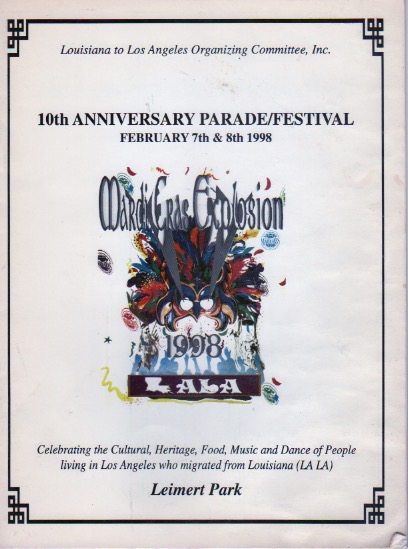
Launched in 1988, the Louisiana to Los Angeles Organizing Committee, Inc. (LALA) Festival has become a cherished local institution of the city’s considerable Louisiana-born and bred population, especially those from New Orleans. Combining the best elements of the tradition bound south with the free spirit of Southern California, LALA offers wealth of Louisiana culture that gets bigger each year. The parades, signature foods such as file gumbo and crawfish etoufee’, Cajun and Zydeco music performances, arts and crafts demonstrations, and of course the Second Line dancing, captures the year-round Mardi Gras spirit of the Crescent City.
The LALA Festival started out as a spring fete in Exposition Park and was moved to the month of February to coincide with the Mardi Gras observance- True, the weather can be less agreeable (even in sunny Los Angeles), but nothing thus far has dampened the enthusiasm of festival participants who have their parasols and proclaim, Laissez le bon temps rouler!”
Many LALA festivals have been held in Leimert Park, the heart of L.A.’s last predominately African-American populace, and a point of origin for many Louisiana migrants who came here in droves around World War II seeking more economic and social opportunities than the segregated south could offer. The migrants brought along their heritage particularly the Creoles. In the Crenshaw District, along the Jefferson corridor came a plethora of Louisiana and Creole establishments: Leon Aubrey’s Barber Shop, Girard’s Market, Henry Marine’s, Pete’s Louisiana Hot Sausage, Harold and Belle’s Restaurant, Sid’s Louisiana Café, Catholic churches such as Transfiguration and St. John of God became social and cultural centers for Louisianans, some of the west coast versions of New Orleans’ organizations are: The Crescent City Lodge, Knights of Peter Claver, Autocrats West, and the very active Jefferson Council. Then ideas for the LALA Organizing Committee came directly from these and other groups that had an ardent desire to preserve the distinct Louisiana culture that may have been in danger of melting down in L.A.’s giant ethnic stew.
Former Los Angeles City Councilman, Bob Farrell, a New Orleans native and longtime L.A. resident, was among those who put some political muscle behind the grassroots effort by enlisting support from the City’s Cultural Affairs Department. It really started out as talks at Aubrey’s Barber Shop on Jefferson,” says Farrell, still an emeritus member of the LALA committee. Farrell continues, “We wanted a public, open celebration of the fun side of our heritage. We were a group of people bound by a lot of common elements – food, religion, place.”
LALA continues to receive support from former City of Los Angeles Councilman Bernard Parks as well as many other local dignitaries including retired Congresswoman/Ambassador Dr. Diane Watson. All of them have Louisiana roots.
Though founded largely by those of Creole-Catholic backgrounds, the festival celebrated the shared traditions of all Louisianans, from New Orleans to Cane River to Shreveport. “Under girding all of this is a real sense of family,” says Farrell, whose family settled in Los Angeles in 1951. “Some values are just with you in your heart. They stay with you.”
Today in addition to preserving the rich Louisiana Mardi Gras culture, LALA raise educational funds for local youth to attend college. The “2nd Liners” perform on TV and at a variety of events including funerals, parties, and parades throughout the year to raise funds for the annual youth scholarships. Each of the traditional Mardi Gras colors have a special meaning: Purple: justice, Green: faith and Gold: power.

