Recap: “Evolution of View Park: Making Sense of Gentrification”


[Expo Park – Los Angeles, CA]  Last Thursday the California African-American Museum hosted the final symposium series on gentrification. The event was created by Karen Mack of L.A. Commons. “Evolution of View Park: Making Sense of Gentrification” featured great audience participation, some solid questions and an excellent presentation.
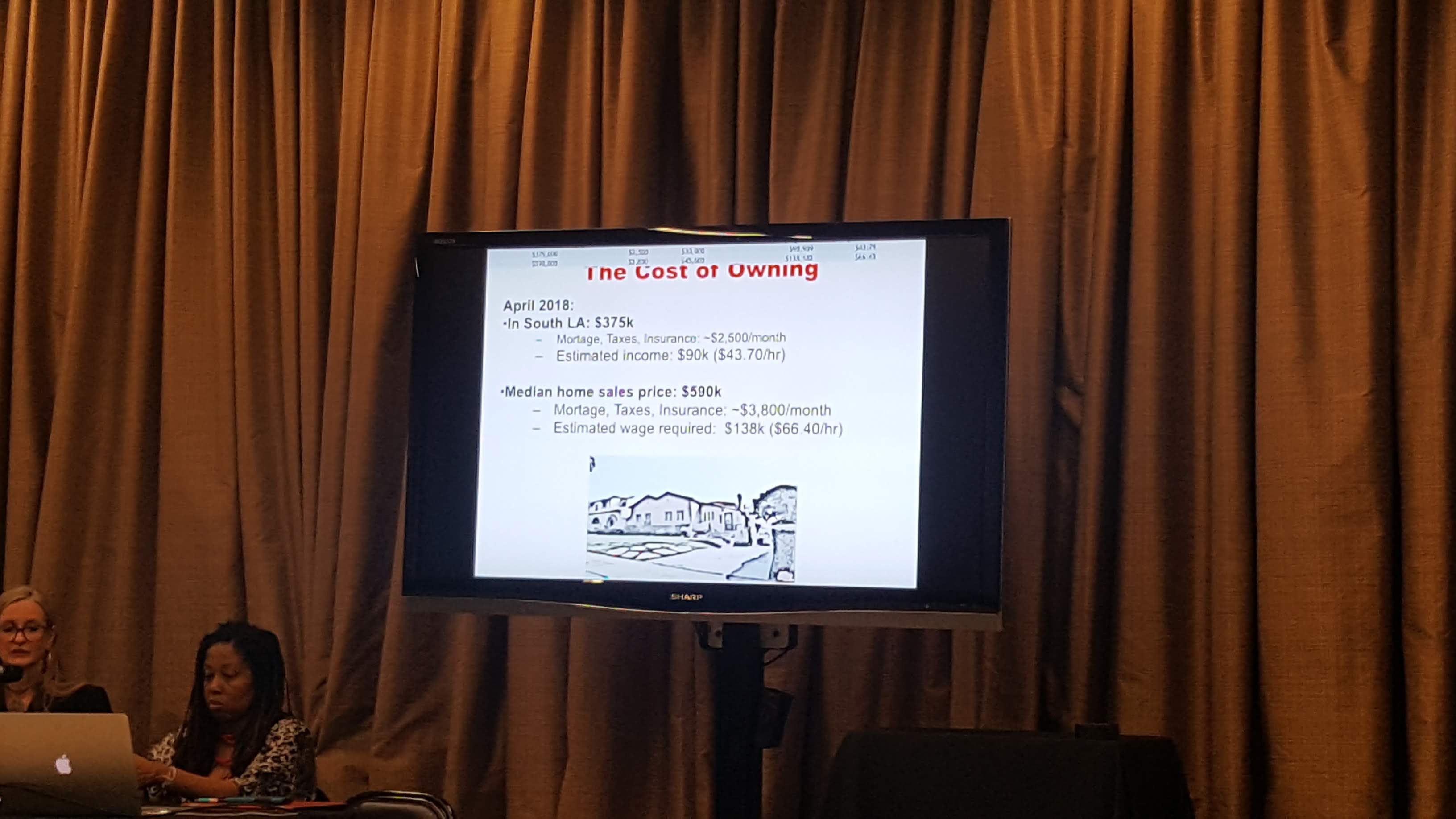
South Los Angeles is ripe for gentrification as the average home price sets at $375K

Complex topic

As mentioned in previous articles on this series; the gentrification topic is very complex and one that can be quite emotional in discussing, particularly from the brave souls in attendance who offered compelling anecdotal commentary.   These types of events are eye-openers as the commentary offered by the audience oftentimes transforms into a venting session which is necessary to put the topic front and center.  However, it can be precarious as the venting can go on and on…….leaving very little room for solutions based strategies to be communicated.


“This series has been so successful Karen should take it on the road” Robert Lee Johnson, Community Author


The event started at 2pm and once again the venue was packed to the brim.  As predicted due to the primary area of discussion; View Park, the majority of those in attendance were African-American.


Crack epidemic in the 80’s


The civil rights movement of the 1960’s as well as the dismantling of racial covenants which previously kept African-Americans from moving into certain communities was critical as there was an increase in the movement towards achieving middle class status through home ownership.


Families grew at an impressive clip.  What gets lost in the whole gentrification discussion, particularly trying to answer the question of if certain neighborhoods or property was hard to achieve why did some of those same families leave and flee to the suburbs and other areas?  For those who cherish Ronald Reagan as an icon of growth while perpetuating the “American dream,” those from the African-American communities have a different perspective.  It is well documented funds needed to fight the Nicaraguan war as well as other conflicts in Central and South America came from the purchase of the readily supply of cocaine.  The product found haven in urban centers across America.  The result was turf battles, killings and other negative consequences which dismantled neighborhoods that were once beacons of progress and hope.  As those areas decayed, it became ripe for reinvestment to replace current occupants.


Legacy and affordability

A key theme or issue which many were seen nodding their heads in agreement was the notion that offspring of those who purchased property in the 60’s, 70’s, 80’s and beyond have great difficulty in being able to purchase their own home, today!  While that is a statement many seem to affirm, it raises many questions.  Did those parents who originally purchased home not do an adequate job in helping their offspring achieve financial literacy?  Due to their successes, did they seem to project a road that their offspring would not have to work or sacrifice like they did?  Why do they assume their offspring cannot qualify for financing, while admitting their incomes are perhaps higher based on the age they first purchased?  It is more complex then assessing those who grew up in the area cannot afford the very area they grew up in.


Reverse racism?


The interest in the symposium topic was obvious based on packed crowds at each event.  There was a strong sentiment of how homeownership was achieved and how it was critical for them to create a legacy for their heirs.  More important was the need for African-Americans to maintain those neighborhoods.


United States history is ripe with laws, regulations, discrimination and other tactics to deprive groups such as African-Americans from owning property or relegating them to specific communities.  Some in attendance were quick to point out their pleas to keep neighborhoods in the hand of African-American should not be construed as defining them as racist.  Technically that would be impossible as racism is using race to oppress other ethnic groups.  African-Americans are not creating any laws or systemic maneuvers to keep any out.


Solutions

As mentioned due to the venting there was more assessment of the problem versus solution.  However, that is to be expected as what Karen Mack organized was a starting point to discuss the issue and that is crucial for stakeholders to speak to their issues.


One important theme offered by those presenting possible solutions was the need to become organized and take a more active role in legitimate organizations.


Due to time the event had to conclude but many in attendance committed to taking this discussion offline and continue to address issues to combat the negative reality of gentrification.


Readers are encouraged to educate themselves on this topic.  Karen Mack may or may not agree to a road show, in the meantime those interested must stay engaged in community platforms such as the one which brought folk together for this series.

Mortgage rates down, job numbers up…..will it be enough to stop the blue wave?


Creating some relief for those obtaining a new mortgage, rates slid down 10 basis points in week over week reporting.  This morning job numbers also posted impressive gains, despite Donald Trump breaking a long-standing policy of intimating the news prior to the official release with one of his early morning tweets.  The issue is the Bureau of Labor Statistics is to be the first voice in officially releasing the numbers, which normally is around 8:30AM .  Period!

In Trump fashion while he did not specifically break protocol, his mere mention was enough to cause consternation for those who treasure integrity from our institutions.


Looking forward to seeing the employment numbers at 8:30 this morning.


These two metrics and other positive signs bode well for those in political control and could be enough to keep them in the driver’s seat.  The unknown is will they be enough to fend off the impending blue wave from the November election that could result in Democrats gaining control of one or both seats of Congress?

Those in control insist the majority of voters are only concerned about kitchen-table issues and pay little attention to the other dilemmas Trump and the ruling party are attempting to deal with.  They are banking on as long as impressive economic numbers are achieved, any other issues are secondary and will keep them in control.

Of course, Congressperson Maxine Waters (D-California) who has been a thorn in the side of Trump and his supporters sent out a warning while appearing on a national news program earlier this year in March.

“for if some reason, Robert Mueller does not get him, Stormy will.”


A recap of the numbers is posted here:

Mortgage

Unemployment


Mortgage rates keep rising


An increase of six basis points is normal within week over week reporting.  However, it is the trend which has many borrowers showing signs of concern.  The benchmark thirty-year mortgage crept to the highest point of 2018 and now sit as 4.610%.  The news was reported yesterday as Freddie Mac released its primary market survey which tracks mortgage rate movement.


A seller’s market


Adding consternation to those in the market to purchase a home is the fact the current market is defined as a “seller’s market.”  That translates into fewer properties on the market, thus buyers have been forced to make competitive offers and the result is higher sales prices.


Those in the market to purchase a new home or refinance their existing mortgage usually take a very cautious position when contemplating a transaction.  The economy has been on a nine-year recovery and each month there has been improvement.  Unemployment is at record lows.  Some have received bonuses or extra money in their paychecks.  All of this may sound good on a political front, however the increase in rates represents higher cost and puts first time buyers in jeopardy as there is added pressure on them to qualify for a loan.


Rates have increased approximately fifty basis points from a year over year comparison


Here is a snapshot of rates for popular programs:

May 17, 2018

30-Yr FRM 15-Yr FRM 5/1-Yr ARM
Average Rates 4.61 % 4.08 % 3.82 %
Fees & Points 0.4 0.4 0.3
Margin N/A N/A 2.77


** each week Freddie Mac publishes the rate survey.  It is retrieved from a sampling from its lenders who sell mortgages to them.  The report is an industry standard and used to gauge consumer mortgage rate movement.

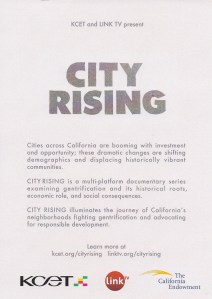
CITY RISING:  A 2017 look at Gentrification


Special Review


[Los Angeles, CA] On September 13th KCET in partnership with The California Endowment hosted the premiere screening of CITY RISING.  The theme of the documentary is gentrification.  An overflow crowd of nearly 700 was on hand to see the “Director’s Cut” which was 90 minutes.  Coincidently, on the same evening KCET showed the regular 60-minute screening on their channel.

If you’re black, get back!

If you’re brown, stick around!

If you’re white, it’s all right!

from an anonymous social scientist


Gentrification, a working understanding

Not every white person is rich and not every black person or those of color is poor!  One legacy of the history of the United States is the construct of racism or using race as a controlling factor.  On basic quality of life issues; from economic or the ability to earn money, to health, to housing and other areas whites were granted privilege over other groups.   Even today many attempt to dismiss this very basic fact of not understanding or accepting the issue in a historical context.


“He who gets behind in a race must forever stay behind or run faster than the man ahead of him, that is our dilemma” – Dr. Martin Luther King, Jr. January 1961 


That privilege buffered by legal discrimination, including specific land covenants of who could buy land or live in certain communities which set in motion the premise of defining the American Dream as being able to afford a home.  Unfortunately, the dream dismissed the reality of certain groups being blocked based on race.


In addition to basic shelter, the more important benefit of home ownership is wealth accumulation or a legitimate asset which has generational benefits.  The lack of it, is one reason for the marginalization.


Inner cities, the target of gentrification


Following the great depression and leading up to the industrial revolution, cities throughout the U.S. witnessed an economic boon.  Labor was the fuel that fed the boon and many ethnic groups relocated and the result was financial uplift.  As the majority group or whites were enjoying the lions-share of the boon, they created the strategy in developing suburbs which allowed them to flee the urban core.  They were able to transfer their properties (through sale or renting) to the minority groups who remained.  Thus, the term “white flight” was coined.  More important and critical to the gentrification discussion is the reality that as whites moved out of the urban core, critical resources were stripped and went with them.   Employment stability left.  Stores left.  Services left.  Resources which are necessary for a community to thrive slowly disappeared.  The result was communities were disseminated and succumbed to blight and other negative forces.  As bad as that may appear the groups who remained didn’t die off.  Instead they created their own identity based on their culture to create a vibrancy which allowed them to thrive and redefine the space they occupied.


Reclamation


City Rising focuses on several communities in California.  They are Santa Ana, Long Beach, Sacramento, Oakland, Boyle Heights and South-Central Los Angeles.


One poignant part of the documentary is discussing the issue of racial covenants which made it illegal to sell property to certain groups.  Many people are ignorant to this reality and dismiss it as being made up or something which happened lifetimes ago.  The sad reality; it is current history regarding real estate ownership.  Assemblyman Hector De La Torre lives in South Gate, CA.  The discussion centered around him showing the covenant as part of the land title documentation which years earlier would have prevented him from purchasing the very home where he was being interviewed.    Even though the practice was outlawed through fair housing legislation, it remained as permanent language within the documentation.  Using his activism as a political leader he created a law which would have required title companies to remove the language from the report.  Unfortunately, even though the law passed, then Governor Arnold Schwarzenegger vetoed it and the language remained as a reminder of the discrimination meted out against certain groups.


The documentary does a good job in highlighting the effects of gentrification.  Even though race plays a huge role in its impact, the subtle reality is the class divide or the “haves versus the have nots.”


Cities that were once thought of as “dead” have sprung to life through various forms of reinvestment.  Interestingly many of the families who fled the urban core, see their offspring take on a renewed pioneering spirit to reclaim areas.  With their economic status, they are able to pick up properties, many on the cheap and with modest investment, transform what was unthinkable into havens of a new lifestyle.  Through this process and focus on redevelopment they are able to attract stores and services which provide a great opportunity, assuming one has the money to operate.


People can only buy your property if you agree to sell


Who doesn’t want to live in a “nice” neighborhood?  The problem with gentrification and this is where CITY RISING shines is as new people reclaim or move back into neighborhoods,  the issue is what happens to the current occupants?  Do they just disappear?  Do they escape in the middle of the night?  For many it’s pure economic, especially the vast majority who are renters.  Those who reclaim properties and invest in the restoration are not motivated by some benevolent gesture, but from an economic perspective so it boils down to return on investment.  The result is the rise of home prices as well as the rise of rents.  Many occupants simply become priced out and that is the ire of those who oppose gentrification.  The community they thought they knew……no longer exist, so they must rebuild their lives or try to coexist with their “new neighbors.”    Some do it very successfully, most don’t because they do not have the leverage of home ownership.


There is much more to this topic.  The causes and effects are worthy of examination.  This documentary does an excellent job in creating a foundation for you to move forward.


See the documentary HERE.