First Time Homebuyers – NOW IS THE TIME


If you are trying to buy a home; First-Timer or otherwise and have 20% down and are otherwise receiving assistance (parent, relative, employer, etc.) this article is not for you.  However, if you are one of the millions who struggle with the notion or question if you will ever be able to purchase a home, this article may provide the inspiration you have been waiting for.

The news is the news, and most traditional sources speak to the high cost of buying a home and the difficulty in ever being able to cross the finish line.  Prices are sky high, interest rates are high, the accumulated cost of the mortgage is enough for even the most stealth person to simply give up.  All we hear is the average cost of home ownership, which is high based on the average but that is just one reality, leaving many to scratch their heads, wondering with all the news how in the heck are people buying homes?

NOW IS THE TIME

Dr. Martin Luther King imploring those to remember Now is the Time!!!!

Even though I am retired, my Broker’s License remains active so on occasions I get calls from past clients or referrals seeking advice on home ownership, mortgages, and the like.  My advice is simple and holds true from all the years I was active – Prices are relative.  Some seem to think “yesterday’s prices were so great or so affordable.”  That may be true but try telling that to someone who purchased during those times.  It has always been a struggle, although admittedly, today’s struggle requires more determination.

DO YOU THINK PRICING IS OUT OF YOUR RANGE? ARE YOU WAITING FOR PRICES TO GO DOWN? ARE YOU WAITING FOR INTEREST RATES TO GO DOWN? ARE YOU HOPING TO WIN THE LOTTERY? ARE YOU WAITING FOR AN INHEIRANTENCE? – Assuming you are qualified and truly want to experience home ownership…… NOW IS THE TIME!!!!!!


Here are some basic tips to help those serious about home ownership.

  • Get Qualified.  Know how much you can afford.  There are many direct lenders, including those online as well as certified mortgage brokers who can provide a legitime approval letter.  Remember home ownership is basic.  For most, the two biggest hurdles are down payment and creditworthiness.  Again, you do not necessarily need 20% or have perfect credit.  Even in today’s higher priced environment, there are plenty of low-down financing options. For those lucky enough to have served in the military and have an active DD214, VA loans are available with ZERO DOWN and no maximum loan amount (of course the trade-off may be a higher monthly mortgage payment but the windfall is not having to pay hard cash towards the down payment).
  • Know your budget.  You may be qualified for a mortgage payment of say $5,000 per month BUT your comfort level may be $2,500 per month.  Stay within your comfort zone.
  • Match your qualification with a property.  This can be tricky as even though you may be qualified for more, the lower priced property may seem undesirable but do not look a “gift-horse” in the mouth.  The key is to stay within properties of your comfort zone.  Again, if not now, when?
  • Broaden your net.  MOST IMPORTANT. Like any good fisherman, the wider your net (of information) the more likely you will find success.
  • Staging, Keep moving.  Staging is great because many want a property that is turn-key or providing a vision of what the home might look like.  Who would not want all the modern furnishing, luxury appliances, fashionable interior appointments, etc.?  That may not be your target because most properties that are staged are at the high-end of the market.  Move on.  Look for something that removes the impulse of all the whistle and belles and instead focuses on getting in or affordability.
  • The sign in the front yard.  Data is real but just remember while the majority who purchase a home might very well purchase where there is a “For-Sale” sign in the front yard, there are many more than you might imagine who purchase a home where there is not a for-sale sign.  Yes, it is the needle in the haystack, but you must think out of the box.
  • The average is the average.  Yes, the average home price might be $400,000 but that does not mean you can’t find anything lower.  Like any commodity, the property may have issues or other factors resulting in lower prices.  Again, the goal is not to find the crown jewel, already furnished property, ready to move-in….it is to find a property you can afford.
  • Network and broaden your sources.  Everybody does not need to know about your business BUT let those you trust know (family, friends, colleagues, church members, social groups, etc.) you are seeking to purchase a home. 
  • Distressed properties.  This is not for everybody but there are homes to be had from those who may be having financial distress or even institutional sources that offer Real Estate Owned (foreclosures) from their inventory – FHA, VA, Freddie Mac, Fannie Mae, etc.  Again, the inventory may be thin, but this is part of broadening your net/reach.  You just never know where YOUR deal will come from.
  • Rent to Buy.  This can also be tricky, but it does represent another legitimate way to obtain home ownership.
  • The Neighborhood.  “I don’t care if someone gave me the property, there is no way I am going to live in that neighborhood.”  That is a real sentiment but remember, a neighborhood is what you make it!!!  Now, that is not to dismiss real negatives which may exist but just remember, there are trade-offs to everything.  If you can get your price, that may be motivation to reconsider the hesitancy. 

What I have communicated is not catch-all or meant for every situation.  It merely represents some basic tips and ideas to encourage you to think out of the box.  Also, just remember, we have not even mentioned the lender incentives but there are enough programs in the marketplace to choke a horse – you simply must be aggressive enough to seek them out and figure how they can apply to your situation.

If you are a homeowner or about to be a homeowner THIS IS A MUST READ


The signs of “White Only” or “Negroes get your food by the back door” have long been removed.  But, the vestiges of racism remain, even in 2022. It is a systemic construct that will not disappear, at least not in my lifetime. Many of us have learned to navigate the treacherous waters that are prevalent in our day to day lives. This article is a prime example and a great lesson for those who might think racism went away when President Lincoln signed the emancipation proclamation or when Dr. King gave his “I have a dream speech.”

The phrase “getting the American Dream” is tossed around as an achievable aspiration. However, history and current reality remind us that preamble wasn’t necessarily meant for us; those who are African American.

In the mid-80’s several well known fortune 100 companies were gobbling up mortgage lenders to create a subsidiary business for their well-heeled clientele who might one day become mortgage customers.  American Express was a key sponsor with the 1984 Los Angeles Olympic Organizing Committee. Once the games ended key staff were directed to apply for post-Olympic employment opportunities with sponsors such as American Express. At the time, I had no clue what a mortgage banker was. My background was marketing. American Express had a subsidiary called Shearson-Lehman and their mortgage banking division was taking off. I jumped at the opportunity. I quickly learned how subjective staff charged with processing and underwriting a loan were; simply based on their upbringing or their societal perspectives. Of course since then a lot has changed but people are people and it is hard to strip away their biases.

Fast-forward to the article, many still swear racism is over and everybody is treated equal. The article points to a very clear, if not painful lesson that many have to endure.  Just when you think you may have “made it” it is examples like this which remind you the work must continue to go forward to break the veil of prejudice and racism.

PLEASE TAKE THE TIME TO READ THE ARTICLE

Blockbusting is not a video game


During the past several years the Black Lives Matter movement has been taken more seriously.  Some, genuinely have made an effort to understand its preamble.  It has evolved into social consciousness not seen in decades.  One issue which has been highlighted from the movement is housing discrimination and how it was strategically used to keep non-whites from reaching their potential to secure home ownership.

Ever since African-Americans were emancipated from slavery strategies, initiatives and even public policy has been used to thwart their progress.  Jim Crow was the moniker used to define that period.  Even though it has been outlawed, to this day its remnants are still part of our environment.  Racial Covenants was the legal process used to keep property from being sold to non-whites.  Legislation from the civil rights era outlawed the practice, however even though non-whites or specifically African-Americans were eventually able to purchase property, a slew of other schemes were developed with the goal to create a negative impact.

One of those schemes was called “Blockbusting.”  In simple terms it literally means to tear up the block or neighborhood.  It was accomplished by telling white homeowners in urban areas to sell their properties to the blacks who were seeking improved housing.  The whites were motivated to sell not from some benevolent position of integrating the neighborhood.  The opposite; they were motivated to act so they could secure whatever favorable price they could achieve which allowed them to move out.


NPR just released an outstanding and more comprehensive article on this topic and others dealing with discrimination in home ownership.

READ MORE

Racial Covenants – what’s that?


From Donald Trump pulling the ultimate political hat trick of losing the House of Representatives, the Senate and the Presidency in four years to the Derek Chauvin verdict, to the treasonous behavior of those who stormed the Capitol on January 6, 2021 to the international sea of millions who adopted the Black Lives Matter moniker, our current environment is that of a social reckoning.

Racially-restrictive deeds were a ubiquitous part of real estate transactions. Covenants were embedded in property deeds all over the country to keep people who were not white from buying or even occupying land

Here in the United States a good many of our social ills deal with race and/or class. People who have been sleep a good portion of their life have awakened. Some ponder the question of the racial disparities placed right on their doorstep. Racism is an institutional construct. In other words the system was created and in many cases codified into law.

The wealth gap presents great data for our divide. On the other hand another element to maintain the gap was racial covenants regarding home or property ownership. They were a tried and true method to keep minorities, specifically those of African descent from purchasing property. It was a little secret but it was law (until in was struck down in 1968) and since it dealt with ownership or property rights, it was part of the official title record. Even though we are in 2021 and the majority of homeowners have no idea of its existence (I mean, who has the time or experience to read a title report?). But, if you ever have the time and look, it is there and its purpose was to legally restrict who could purchase property.

Today the Los Angeles Times explored the topic in greater detail. So, I would encourage you to educate yourself of how these elements created the racial disparities that is current social discussion is attempting to correct.


LOS ANGELES TIMES – THE UGLY AND TRUE HISTORY OF RACIAL COVENANTS

California Real Estate Market Booming Even As COVID-19 Pandemic Continues


The above headline is what scares the hell out of would-be homebuyers. As real as the numbers are they are just another hurdle which must be navigated to achieve homeownership.


In December, the statewide median home price was $717,930, up 16.8% from December 2019. But the high prices are not driving buyers away.

The notion of buying a home at $700,000 is one factor which scares many potential buyers into paralysis. While financing is attractive there are hurdles which cause some to simply throw in the towel before even trying. Make no mistake, the aspiration of purchasing a home can be a daunting experience. Several important factors to consider:

  • The story projects great news for those who have succeeded in purchasing a home during this worldwide pandemic. But who has the $140,000 or even $70,000 or $35,000 required down payment stashed away?
  • Using the “average” sales price as a barometer, how many first-time, would-be buyers can afford a monthly mortgage payment of approximately $3,700?
  • Further, based on the above how many “average” people have the income to qualify for a mortgage? Using the above illustration you would need a combined annual income of approximately $115,000.

THE BOTTOM LINE

There is no need to stay discouraged. Even in the best of times acquiring a home requires planning, persistence and laser-focused attention on succeeding. While the numbers are the numbers the fascination in purchase a home is there is the “average” and then there are options. It may mean you will have to do more research. Think out of the box. Be creative. All, with the focus of getting in, somewhere!!!!!! The one constant is however you achieve it, homeownership is a coveted goal and despite the nerve-wracking numbers in the long-haul you can position yourself for financial mobility while meeting a very basic demand………securing shelter.

The last critical point is to network and align yourself with professionals who can help to minimize the myths and set you on the path to achieve, and that may not be the $700,000 home but whatever it may be, it will be yours. Why? Because not everybody sells for the same reason or has the same motivation other than to sell to the buyer who can meet their price and their timeline.

Conforming Loan Limits increased


above photo Mel Watt, director of the Federal Housing Finance Agency (FHFA), from left, Jerome Powell, chairman of the U.S. Federal Reserve, Steven Mnuchin, U.S. Treasury secretary, and Jay Clayton, chairman of the Securities and Exchange Commission (SEC), listen during a Financial Stability Oversight Council (FSOC) meeting at the U.S. Treasury in Washington, D.C., U.S., on Tuesday, Oct. 16, 2018. Powell said at the meeting he is worried about a spillover from hard Brexit, but stocks and Treasuries showed little reaction. Photographer: Andrew Harrer/Bloomberg via Getty Images


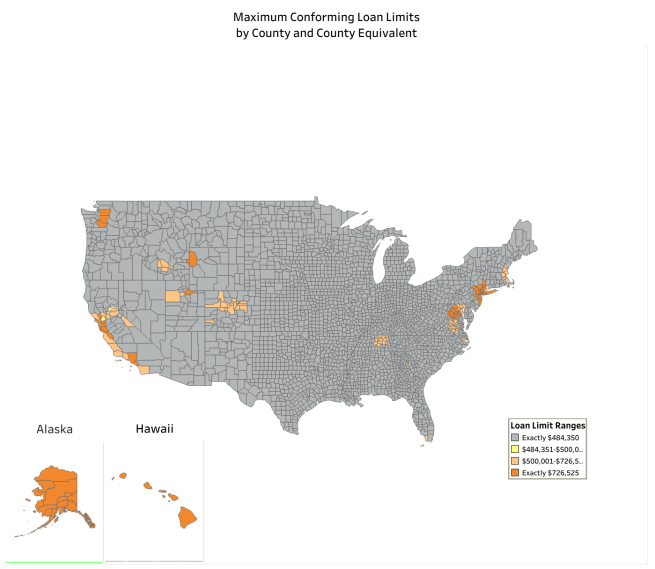
Today, the Federal Housing Finance Agency (FHFA) announced conforming loan limits would increase from $453,100 to $484,350.  For higher cost areas (see map below) the new limit will be $726,525.  FHFA was created as the umbrella agency for the Federal National Mortgage Association (Fannie Mae) and the Federal Home Loan Mortgage Corporation (Freddie Mac).

Fannie Mae Headquarters, Washington, DC (Photo by Alex Wong/Getty Images)

Freddie Mac Headquarters, McLean, VA (Photo credit should read PAUL J. RICHARDS/AFP/Getty Images)

They purchase home loans from a network of lenders across the nation.  The lenders originate the loans from consumers who are seeking to finance their home purchase or to refinance their existing mortgage.  The lenders also work with mortgage brokers, credit unions and other organizations who have direct contact with consumers.

Once the loans are funded, they are packaged and sent to respective investors (i.e., Fannie Mae and Freddie Mac) and sold as securities, which are backed or collateralized from the property.


The Impact

Nationally the average loan amount is $229,000.  The new guidelines take effect for mortgages that originate starting January 1, 2019.  The increase will help those who see home prices continue to rise.

Conforming loans are those where the loan amount is $484,350 OR LESS.  Any loan amount in excess of that loan is defined as a “Non-Conforming” loan.  For borrowers the impact is typically ½ point or 50 basis points on the interest rate.


As an example based on current limits

Loan Amount Rate Payment Mo. Difference
$453,100.00 4.81% $1,816.00 -$188.00
$453,101.00 5.31% $2,004.00

The bottom line difference could be approximately $190 each month.  So, while the monthly payment is crucial, the move also provides those with higher loan amounts an additional $31,250 to deal higher prices, while being able to obtain more affordable interest rates.


Mortgage rates jump to near 5%


COVER PHOTO.  Traders work on the floor at the closing bell of the Dow Industrial Average at the New York Stock Exchange on October 10, 2018 in New York. - Wall Street stocks plunged Wednesday, with major indices losing more than three percent in a selloff prompted by the sudden jump in US interest rates. At the closing bell, the Dow Jones Industrial Average had lost 3.1 percent or 830 points to finish at 25,613.35, in the biggest fall since February. (Photo by Bryan R. Smith / AFP) (Photo credit should read BRYAN R. SMITH/AFP/Getty Images)

Mortgage rates jumped to 4.90% which is a number not seen in nearly seven years based on Freddie Mac’s weekly rate survey.  Although an increase was expected the jump of nineteen basis points caught some by surprise.  As strong as the economy is purchasing a home continues to be an illusive transaction for many.  The rise in rates buffeted by the increase in home prices have left many reconsidering their plans as evidenced by the drop in mortgage applications.

Remember that tax break earlier in the year?

Last December president Trump and the GOP controlled congress touted the tax cut as a “cure-all” and justification of their leadership prowess.  Indeed, a good chunk of working people did receive benefits from the tax cut and a few were lucky enough to get bonuses.  The average cut was about $1,600.


For those who were positioning to buy a home or refinance their existing mortgage the recent mortgage rate hike has wiped out that savings.

Time Rate Payment Annual
Oct. 2018 4.90% $1,252
Oct. 2017 3.90% $1,113
Diff $139 $1,668
**based on average mortgage of $239,000

Cyclical

Most understand rates and economic metrics are cyclical.  In other words when you have an improved economy, you will also see a rise in consumer goods.  Also, recently the Feds increased the discount rate.  This was done as a preventative measure to thwart inflation.  Normally political leaders stay out of the Fed’s business but Donald Trump has continued to intimate their move has contributed to rate increases claiming they will result in a negative impact.

“I think the Fed is making a mistake. They are so tight. I think the Fed has gone crazy,” President Donald Trump 

Tariffs

Another pressure-point for the economy is the recent drop in the DOW Jones and financial markets.  Business leaders, especially those in the real estate sector attribute the decline to the uncertainty of the Trump imposed tariffs and other measures.  They feel recent gains may be wiped out.

“These tariffs will translate into higher costs for consumers and U.S. businesses that use these products, including home builders,” Randy Noel, chairman of the National Association of Home Builders 

Here is a snapshot of this week’s rate survey

October 11, 2018

30-Yr FRM 15-Yr FRM 5/1-Yr ARM
Average Rates 4.9 % 4.29 % 4.07 %
Fees & Points 0.5 0.5 0.3
Margin N/A N/A 2.77
Freddie Mac produces the weekly rate survey.  It is the industry standard for consumers and mortgage professionals to gauge consumer mortgage rates.


Mortgage Fraud on the rise


Today mortgage information provider CoreLogic released its “Annual Fraud Report” documenting a rise in consumer mortgage fraud.  The report highlights that recently convicted former Trump campaign manager isn’t the only one who submitted false applications to secure mortgage loans.  As in the case of Manafort, mortgage fraud is a federal offense and the penalties can be stiff, including incarceration.

ALEXANDRIA, VA –  Manafort was charged with financial frauds and is the first defendant in special counsel Robert Mueller’s investigation into Russian interference in the 2016 presidential election to face trial. (Photo by Alex Wong/Getty Images)


Even though the economy has improved, the rise in home prices and corresponding amount of income needed to qualify for a loan has increased.  Although it is a risk management issue the numbers note approximately 1 in 109 applications have some type of fraud.  The report reflects the fraud index has increased for the past seven quarters.

Two fraud issues that are top of mind for risk managers right now are false credit disputes and income misrepresentation.

Video discusses the report shown here

https://players.brightcove.net/75895570001/EJUJuZYOl_default/index.html?videoId=5822617829001


Unemployment numbers dip to 3.7%


US President Barack Obama shakes hands as Republican President-elect Donald Trump thanked him for creating a positive economy. JIM WATSON/AFP/Getty Images)

Publishing numbers not seen since 1969, yesterday the Bureau of Labor Statistics (BLS) released its October jobs report.  The numbers reflect data compiled for the month of September as unemployment dipped to 3.7%, with new jobs pegged at 134,000.  That is good news for the Trump administration as it validates their message of a strong economy.  The news was expected and comes at a good time for them as even though they inherited the foundation of a good economy from the Obama administration, they have been mired in a string of self-inflicted blunders ever since taking over the reins. 

They view those blunders as attacks from those who are upset they won the 2016 election.  Others view them as leaders who are inexperienced at managing a government, fraught with suspicious characters linked to criminal behavior.

In addition to the Mueller investigation, they are dealing with a majority of the public not in support of their United States Supreme Court nominee, Brett Kavanaugh.  Earlier today Kavanaugh squeaked by with a 50-48 vote.  While there is jubilation from those who support Trump and Kavanaugh, the untold cost may not be realized until the mid-term vote slated for November 6th.   Some fear this and other moves by the administration might cost the GOP control of congress.

Sen. Elizabeth Warren (D, Mass.) speaks to protestors gathered at the steps of the US Supreme Court as the Nation waits for the expected confirmation Judge Brett Kavanaugh, in Washington, D.C., on October 6, 2018.
(Photo by Bastiaan Slabbers/NurPhoto via Getty Images)


Trump understands the media dynamic

As September numbers are a positive sign, Trump no doubt will use the data to proclaim the numbers reflect the lowest, specifically among African-Americans and other minority groups.  While the numbers are real and give great justification to those who support Trump, it must be noted he is a master manipulator of the spoken-word and you really have to ponder how serious he is about the claim?  Or, is he appeasing to the conscious of those who have very little knowledge of the historic perspective of employment gaps between whites and minority groups?  Oftentimes they view any news spouted from Trump as near-gospel, certainly not worthy of understanding the overall context of such statements. 


Understanding media, Trump has woven unemployment data into his rallies and other talking-points.  The issue for some regarding this sentiment is whether Trump is genuine, as his tone appears to mock the point which is a very serious issue for African-American’s who have been systemically unemployed at a rate at least twice that of whites.  This has been lingering problem presidents have been dealing with ever since the notion of race entered the American nomenclature.  It was created to divide people and groups.  While the numbers in fact have declined, the real gap is a constant historical fact; a key metric providing evidence to the wealth gap that highlights the polarization of our nation. 

In attempting to proclaim his support for the African-American community, who can forget this quote Trump made while on the campaign trail?

“Oh look at my African-American over here,” Mr. Trump said. “Are you the greatest? Do you know what I’m talking about?”


OMAHA, NE – MAY 4:
Isaiah Hall, 21, responds to a question from Crystal Sauser, a public relations manager, during a job interview at AirLite Plastics in North Omaha on Friday, May 4, 2018, in Omaha, NE. “We’re going to offer you the position,” Sauser said, and the stoic face Isaiah began to melt into a smile. Isaiah finally had a job.
Only seven of the overall 13 students (one student started a day after the initial 12 students) would make it through the training and to this morning of job interviews.
Over the past decade, concentrated efforts by various organizations in Omaha have helped drastically drive down the unemployment rate among African Americans, particularly in North Omaha, which is majority Black. While Donald Trump brags about how he has helped lower the national unemployment rate among Blacks, the city of Omaha has shown how a small group doing targeted employment bootcamps and workshops can help boost statistics with minimal help from the local, state, or federal government.
(Photo by Jahi Chikwendiu/The Washington Post via Getty Images)

Indeed, unemployment numbers are down but a nagging question remains which is why is there a disparity with white workers versus other ethnic groups?


“Among the major worker groups, the unemployment rates for Whites
(3.3 percent) declined in September.  Blacks (6.0 percent), Asians (3.5 percent), and Hispanics (4.5 percent)stagnation”  Bureau of Labor Statistics (October 2018)


The jobs report will continue to boast consumer confidence.  However, the issue for many is keeping pace with rising consumer cost.  The Fed’s recent rate hike is the reality of a cyclical economy.  Some things go up and others go down.  As an example, housing prices continues to soar resulting in many who are employed to delay buying a home, simply because the percentage needed from their paycheck to handle the monthly payment has increased year over year.

Here is an example of 1969:2018 –   Wages & percentage of income needed for monthly payment.

Monthly Income Home Price Int. Rate P & I Pct. Of Income needed
1969 $492 $24,400 8.42% $186 38%
2018 $4,326 $539,000 4.75% $2,811 65%
Averages based on California

Reverse Mortgages:  Tougher guidelines effective today


(cover photo by Mindy Schauer/Digital First Media/Orange County Register via Getty Images)

(Photo by Liz O. Baylen/Los Angeles Times via Getty Images)

Reverse mortgages, technically known as Home Equity Conversion Mortgages (HECM) have tougher underwriting guidelines effective October 1st.

The announcement was made by the Federal Housing Administration (HUD) which is part of the United States Housing and Urban Development (HUD) agency.  HUD insures the mortgages which are originated by lenders at the consumer level, thus allowing borrowers a tool to utilize the equity in their homes to obtain a loan.


The move essentially means in addition to the initial appraisal used to determine property valuation, a second independent appraisal will now be required.  The borrower’s loan will be based on the lower of the two appraisals.  In a gesture to appease the borrower’s chagrin of the new requirement, the cost of the second appraisal is allowed to be financed as part of the closing costs.  In making the move HUD announced it needed extra protection for the collateral being used to obtain the loan, as it battles with a shrinking insurance pool.


House rich, cash poor

HECM’s have picked up in popularity since the early 2000’s.  As people have lived longer lives, it was a statistical reality that many seniors were dealing with a precarious situation.  For a variety of reasons their cash reserves were being depleted and the result was a negative impact to their day-to-day living.  It was also noted many in that population who were homeowners were sitting on large equity positions.  Unfortunately, underwriting guidelines made it prohibitive for them to obtain standard mortgage loans.

HECM’s solved that solution, at least for those who were at least 55 years of age and had sufficient equity.  Instead of a regular loan where you make monthly payments, the loan actually provides the borrower income based on the equity position.  Paying off the debt was not required until the borrower deceased or it was somehow refinanced.


The new guideline is not expected to thwart the popularity of the program.  But, it is one critical guideline that HUD feels will help sustain the viability of the program.

Read the updated guideline here