The one bank indicted from the mortgage crisis of 2008


The mortgage or housing crisis erupted across the nation in 2008 and crippled the U.S. economy.  Institutions, companies, cities, communities and individuals were not spared its devastation.  Even though recovery was a painful process and total restoration is a fleeting hope for many, it was felt those responsible, especially the well-known companies and their corporate leadership would eventually be held responsible for their involvement.


Shockingly, of all those who may have been involved in the nuances of mortgage lending and whose decisions resulted in historic loses, only one bank was indicted by the federal government.  Abacus Federal Savings and Loan headquartered in New York was dealt the wrath of selling fraudulent loans to the Federal National Mortgage Association (FANNIE MAE).


Too Big to Fail

You remember the panic, the desperation and the commentary from our political leadership? Most had never heard the phrase, “too big to fail!”  They would quickly learn it was akin to one of the great Chick Hearn phrases in announcing a basketball game, “no harm, no foul.” That basically meant that even though a foul may have been committed by the opposing player, it was not deemed worthy of declaring a foul or infraction.

2008 photo Ben Bernake, President George Bush & Hank Paulson

Instead, countless banks and mortgage originators were fined billions by various regulators, however there was no criminal prosecution as was the case with Abacus.  Even today there are many raw nerves, emotions and opinions when the topic of the mortgage crisis is discussed.  The how and why of Abacus being targeted raises more questions than it answers.  In 2016 a film about the plight of Abacus and impending trial was released.  Frontline, which specializes in showing documentaries on the public broadcasting network platform released the television version on September 12, 2017.

This spread the danger of risky mortgage loans, systematizing the housing market’s risks throughout the global financial system.23 These developments occurred in an environment characterized by minimal government oversight and regulation and depended on a perpetually low-interest rate environment where housing prices continued to rise and refinancing remained a viable option to continue borrowing.  When the housing market stalled and interest rates began to rise in the mid-2000s, the wheels came off, leading to the 2008 financial crisis.

Low hanging fruit

Abacus was eventually vindicated as the government was not able to prove their case.   Whatever your thoughts are about the crisis or your familiarity of the case, you ponder and ask what was so unique about Abacus that the government thought them to be “the poster of criminal intent and deemed a responsible party?”  There were so many well-known companies that were involved in the crisis.  As a matter of fact, each day lenders were imploding right before our eyes.  No doubt, they represented low hanging fruit that even a rookie prosecutor could attempt to give the public some sense of relief through indictments..  Yet, absent those who managed to survive and keep the doors open, their core penalty as mentioned was having regulatory fines levied against them.    From their perspective, dealing with a fine was much better than going out of business or worse, having to spend time in jail or prison.


Abacus goes down in history by being the only bank or mortgage lender to suffer the fate of being indicated and having to go through a full trial.


You can access the full film by clicking HERE

Mortgage rates slip to lowest point of the year


Generated by IJG JPEG Library

Mortgage rates which have been sliding during the past several months reached their lowest point of 2017.  As reported by the weekly Freddie Mac Primary Market Rate Survey, the benchmark 30-year mortgage dropped another four basis points in week over week reporting and came in at 3.780%

The dip was attributed to the 10-year treasury yield which also fell to new lows at 2.061%.  Of all financial indicators which influence mortgage movement, it is the 10-year treasury yield which is the most predominant.  At the beginning of the year there was much optimism that the Trump Administration could jumpstart economic growth and inflation by cutting taxes and regulations.  However, with the administration not being able to claim any legislative victories investors are wondering whether they have the will to move the economy at a faster pace.

The effect

Rates are cyclical and will not always drop, however the recent national disaster of hurricane Harvey will have an effect in consumers applying and qualifying for mortgage.  Low mortgage numbers are great but you still have to be able to qualify based on your credit and condition of the property being used as collateral.  One of the first economic data points of Harvey was the BLS report reflecting unemployment claims.   The report showed that claims jumped 62,000 from week over week reporting and came in at the highest level since 2015.  That is worth mentioning as there as several more hurricanes, with equal or greater strength which is slated to hit the United States within the next several days.


READ THE REPORT HERE

Based on Harvey and other pending hurricane’s which primarily affect regional economics, consumers can expect a broader impact resulting in rates remaining at their current level.  The big question is with all that is going on, can consumers switch gears and be concerned about mortgage money?

Current rates

September 7, 2017 (based on Freddie Mac weekly rate survey)

30-Yr FRM 15-Yr FRM 5/1-Yr ARM
Average Rates 3.78% 3.08% 3.15%
Fees & Points 0.5 0.5 0.4
Margin N/A N/A 2.74

Mortgage rates continue to dip as do employment numbers


For most the quarter mortgage rates have been below 4%.  There has been a steady drip in week over week reporting and currently they ended August at 3.820%, which was down four basis points from the previous week.  The rate reported is for the benchmark 30-year Fixed Rate mortgage.  A full recap of popular programs is listed below:

August 31, 2017 (Freddie Mac Primary Market Rate Survey)

30-Yr FRM 15-Yr FRM 5/1-Yr ARM
Average Rates 3.82% 3.12% 3.14%
Fees & Points 0.5 0.5 0.5
Margin N/A N/A 2.74


As more consumers are purchasing homes or refinancing their existing mortgages, tighter competition for affordable mortgage money could be the result.  Thus, experts suggest the trend may reverse as rates move higher.  Of course, that is the projection but for now the current rate range appears stable.


Rates for the most recent week were posted Thursday or August 31st.  However, on Friday, September 1st the Bureau of Labor Statistics released monthly employment numbers for August.  While many were jubilant that July’s numbers exceeded expectations, August numbers brought them back to reality as there were 156,000 new jobs reported.  That number was a sharp reduction from July, and way below the 2016 monthly average of 187,000 new jobs.


Harvey


Of course, with the disaster of hurricane Harvey and other regional issues both mortgage and employment data should see some immediate adjustments.  Construction employment surely will see a pick-up, however in the Texas region there is some concern as industry experts peg undocumented construction labor at nearly thirty percent.  Based on the Trump administration unpopular focus on building “the wall” and removing undocumented people from the United States, many from that population are petrified of being targeted resulting in their unwillingness to come forward and perform jobs they have done prior to the attention of their plight.  The bottom line is if these workers are unavailable the cost of recovery will be much higher.

Mortgage Rates unchanged, unemployment numbers decline


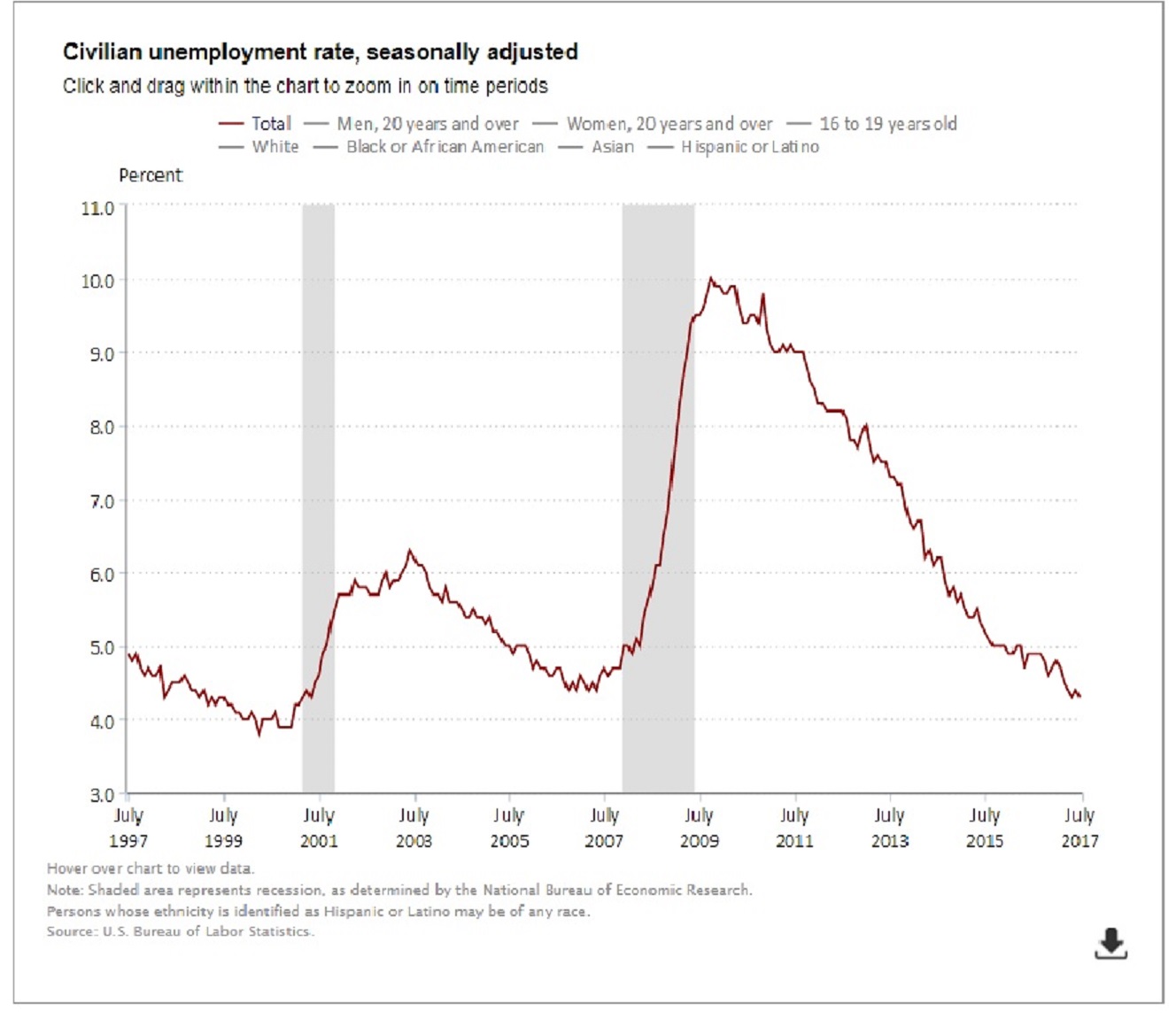
bls jobs aug 2017

For the first reporting week of August, mortgage rates were basically unchanged and came in at 3.930% or up one basis point in week over week reporting.  Unemployment numbers for July were released and they reached the lowest level in years as they came in at 4.3%.


Both numbers are critically important to consumers and is also closely monitored by economist and policy makers.


The mortgage numbers were projected as rates have held steady for the past several months.  Affordability is also an important issue as those seeking to purchase a property have seen prices increase due to supply.  The 3.930 is for the benchmark 30-year mortgage.  The popular 15-year mortgage also held steady and sits at 3.180% Both numbers are from the Freddie Mac Primary Mortgage Market Rate survey which is an industry standard in gauging mortgage rates on a national basis.    For more information on mortgage data please see here.


Employment Data

The employment data exceeded projections and represented good news for the Trump administration.  For them, this week has been another roller-coaster ride and their lack of communicating honest information, instead of having to retract one issue after another has made the public less confident in their ability achieve some of the basic issues they campaigned on.


Job gains occurred in food services and drinking places, professional and business services, and health care.


For those in the workforce the big issue remains flat wages.  For more information on the employment data please see here.

Mortgage rates climb back towards 4 percent


rates 762017


As predicted, mortgage rates climbed eight basis points in week over week reported and now sit at 3.960%.  The move was expected and based on the shortened trading factoring the July 4th holiday.  Therefore, the two-point gain from last week was wiped out.

Positioning

Overall rates are very attractive for home buyers as well as those seeking to refinance their existing mortgage.  The key for most consumers to take advantage of rates is positioning or being able to make a formal application and having the ability close within a reasonable period of time.  Refinancing can be trickier as many lenders lock in the rate for 60 days at time of preliminary approval.  Consumers completing a purchase transaction are guided by the close of escrow, so locking before that time might be unavailable.

Supply and Demand

While the 10-year treasury bond is the key instrument in gauging mortgage movement, there are other factors to consider such as the overall economy and even world events.  Supply is demand triggers movement up or down.

credit – Freddie Mac

Mortgage applications have been stable, however should there be a surge the result may be higher rates.  Just this month, lenders are preparing for more applications as underwriting guidelines have changed which may motivate more borrowers to consider a transaction.

Rate Recap here

The Freddie Mac Primary Mortgage Market Survey® (PMMS®) has evolved since its inception in April 1971 into the foremost reliable, representative source of regional and national mortgage rate trends and is relied upon by the mortgage industry and the public in gauging market conditions and evaluating mortgage loan options.

Mortgage applicant’s catch a break


Embed from Getty Images


If you are trying to purchase a home or refinance your existing mortgage, starting this month the break you may have been hoping for is here.  At least for those on the margins who may have lower credit scores or excessive debt to income.

Tax liens and civil penalties may be dropped from your credit report, thus allowing your score to increase.  Additionally, Fannie Mae and Freddie Mac who are the two largest institutional mortgage providers who purchase mortgages from their large cadre of lenders will allow borrowers debt to income ratio to move from 45 percent to 50 percent.

The impact

Tax liens and civil penalties can be a thorn for borrowers who sometimes don’t find out about them until late in a transaction.  The issue is sometimes they are not 100% complete or may contain erroneous information.  If that is your circumstance and you can document your position, the three credit reporting bureaus cannot report them as being authentically delinquently, thus your credit score will not reflect them as negative.

Again, this is critical if you are at the margins of being defined as having great credit versus good credit, or good credit versus poor credit.  As an example, most lenders use risk based pricing to determine which interest rates borrowers will be afforded.


Using a first-time buyer for the sake of illustration on a $200,000 mortgage, using today’s benchmark 30-year mortgage at zero discount points, equals 3.875%.

Great credit, FICO above 720. payment is $940 per month.

Good credit, FICO below 720 but higher than 680, rate is 4.125% or to obtain 3.875% discount points of 1.250% must be applied.  Payment is $969 per month or to achieve $940 payment, discount points of $2,500 must be paid.

$29 difference does not seem like a lot of money but over time you are paying more than necessary.

This is just a crude example but as you can see your credit score will determine which rate you are offered and before the announcement, lenders were required to put the information on your credit report as it was assumed to be accurate.

The other component where borrowers may get some breathing room is the increase of the debt to income ratio.

Again, using the $200,000 mortgage as an example and a purchase price of $250,000, assume taxes and insurance are $300, so the total mortgage payment would $1,240.  Assuming you have $1,000 in debt, so your total housing debt based using basic underwriting guidelines would be $2,240, thus you would need a gross household income of $5,600 per month to gain mortgage approval.  With the new guidelines, you now would need just $4,480 per month.  The difference is a whopping $1,120 per month and that could represent the opportunity to qualify for a larger mortgage which is crucial as home prices continue to rise or you simply could easier qualify for the mortgage of your liking.


Of course, there are critics to these two changes as some reflect back to the housing crisis of 2008 as well as the core reasons which led to the downfall.

At the same time, many lenders feel their portfolios are healthier and the benefits outweigh the risk, particularly as application production has been tepid, if not flat.

If you are in these two categories the best advice is:

  1. Present your documentation or your dispute to the three major credit reporting agencies Equifax, TransUnion and Experian.
  2. Check with your lender or mortgage originator to make sure the mortgage is based on Fannie Mae or Freddie Mac underwriting guidelines, and to determine if the new debt to income levels are in place.

references

Fannie Mae

Freddie Mac

Equifax

Experian

TransUnion


Mortgage Rates Dip 2 points


Embed from Getty Images

The bench rate 30-year mortgage fell two basis points from week over week reporting as noted by the Freddie Mac Rate survey.   Despite treasury bonds rising the dip was attributed to the survey being completed prior the sell.  Consequently, next week and forward consumers can expect rates to rise as treasury yields are expected to climb as well.

Rates are cyclical and even though 10-year treasury bonds are the predominant indices which creates movement, there are other economic events to consider when attempting to peg the right time to purchase a new home or refinance an existing mortgage.

The purchase market has been hot and even though rates remain affordable the challenge for most consumers is being able to afford or justify the higher prices.  For those seeking to refinance the challenge is presenting acceptable credit and as well as a property with enough lendable equity.

Here is a snapshot of this week’s rate survey based on year over year data:

Product Current One Year Ago
30 YR FRM 3.88% 3.48%
15 YR FRM 3.17% 2.78%
5/1 ARM 3.17% 2.70%

2012 Mortgage in Review


2012 Mortgage Market: Year in review

As we wrap up 2012, the good news is the average mortgage rate[1] did not go above 5.000%.    Data analyzed at the end of 2011 was the justification for our prediction and the year proved “normal trends” were redefined.  The rate ends 2012 at 3.350%.  For all of 2012, the rate never rose above 4.000% and the yearly average wound up at 3.648%

Those consumers who could qualify for a traditional mortgage or who were eligible for one of the Obama administration “Making Homes Affordable” programs nabbed historically low rates.  The dollars shaved off their monthly mortgage payments as well as overall interest savings was welcome news to the economy.  Many more consumers took another road and used the lower rates to reduce their mortgage terms.  The 30 year term was quickly replaced by the more popular 20 year or even 15 year term.  The bottom-line was repositioning and improving their financial health.

The Economy

Mortgage payments are most consumers’ largest household expense.  The rates of 2012 were too good to pass up for those who refinanced.  Just as important, they provided a solid reason for those in the important purchase market to snap up bargain, just before the housing market improves and pricing heads back up.   The rate metric helped an otherwise tepid economy show steady gains.

The Election

It was forecast rates would be very stable up until the national Presidential election.  Even though candidate Mitt Romney claimed to be stunned he did not win, now that President Obama was granted another four years, voters as well as the general public will insist the economy show more robust improvement.   As that happens and consumer confidence improves, the result will be an increase in rates.

In the meantime, 2012 saw a very stable rate pattern which did not move higher than six tenths of one percent.

[1]  Conforming 30 Year Fixed Rate Mortgage

The Week Ahead:  Low unemployment numbers and low mortgage rates


Embed from Getty Images

The Week Ahead:  Low unemployment numbers and low mortgage rates

As consumers start the week ahead they hope to slow down the roller-coaster ride experienced last week

Higher prices at the gas pump continued to threaten their confidence and dampened what was a pretty good week.  Historically, unemployment numbers came in at the lowest levels in nearly four years.  Settling in at 7.800%, the numbers point to an economy that may finally provide a larger pool of desperately needed consumers to fuel the type of economy some have been predicting for months.

Just as impressive as more people getting some type of paycheck to participate in our economic recovery, is starting the week with lower mortgage rates.  The week starts with the traditional 30 year Fixed Rate Mortgage at 3.360%

Housing and employment are two critical metrics in evaluating the economy.  Obviously the more people employed, the more they can position themselves to qualify for a mortgage loan. Low mortgage rates provide consumer confidence in making a commitment to invest in what may be the largest purchase in their lifetime.

To further illustrate the relation between historic low rates and the unemployment data, the last time unemployment was below 8.00% or 7.800, mortgage rates were 5.050%.  Another way to analyze the data would be to compare a typical mortgage payment:

Average mortgage $175,000

October 8, 2012 3.360% = $772

January 2009 5.050% = $945

DIFFERENCE = $173 per month

Even though employment data has struggled for nearly four years to boast confidence, lenders are on the supply side and are projecting an increase in mortgage applications.

In the week ahead, consumers will continue to see rates around the 3.400% range.  On the other hand, most consumers understand that rates are cyclical and don’t always go down or up, week after week.  For those on the sidelines, who meet underwriting qualifications and have yet to make a move, their challenge is does 3.360% represent the low point or will it be lower on Thursday, or will it start to inch back up because more consumers are in the marketplace?